
AI & computing
DGX Spark, HP ZGX Nano or RTX PRO 6000: which hardware for local AI?
NVIDIA DGX Spark, HP ZGX Nano or RTX PRO 6000 Blackwell: memory, bandwidth, power and use cases compared to choose the right hardware for on-premise AI.
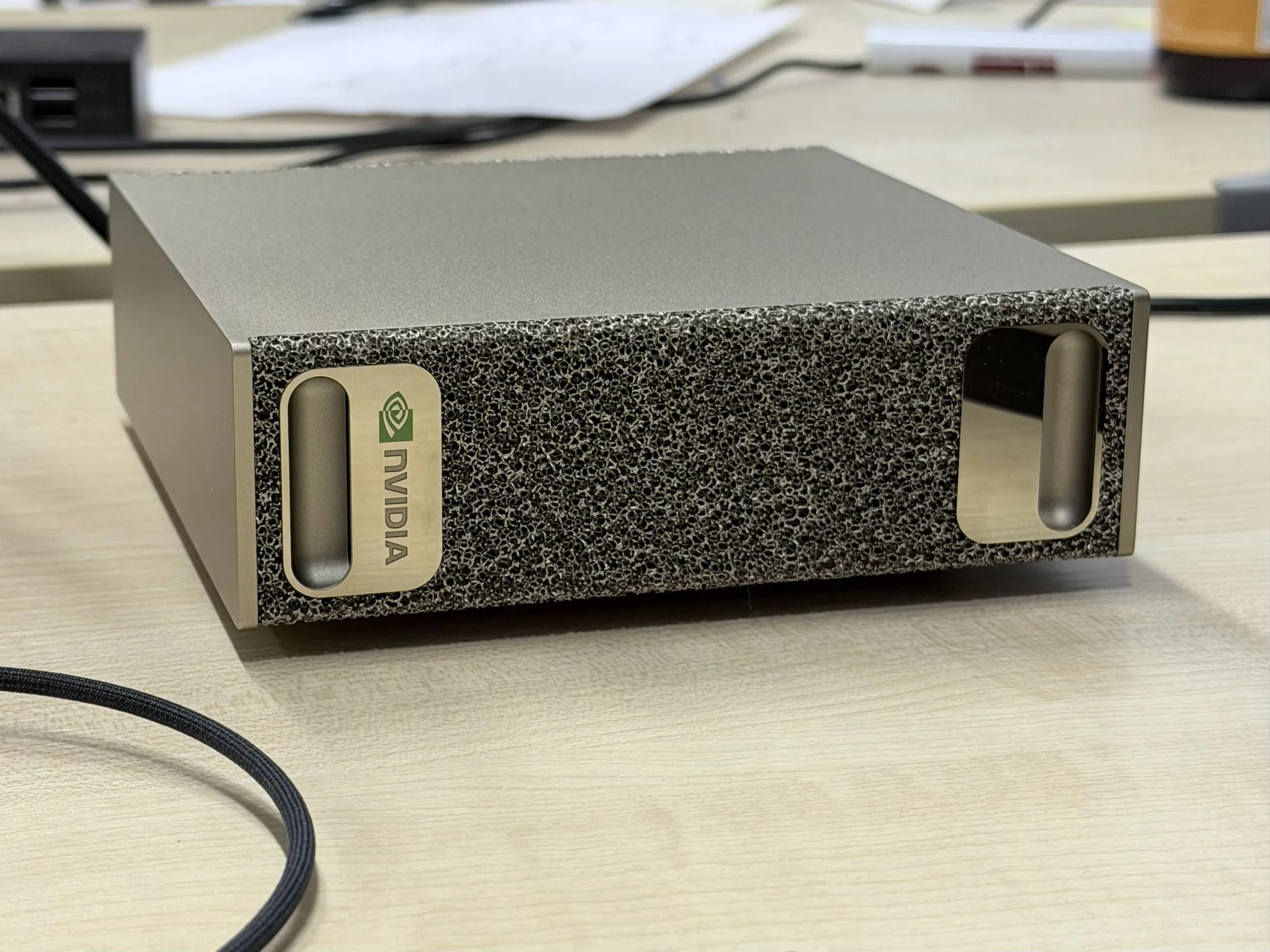
Running an AI model on your own premises, without sending your documents to the cloud, calls for specific hardware. Three options come up in almost every request we receive: the NVIDIA DGX Spark, its branded equivalents such as the HP ZGX Nano, and the NVIDIA RTX PRO 6000 Blackwell card fitted in a workstation. They do not meet the same need. This guide compares their actual specifications and helps you choose according to your models, number of users and budget.
The three options at a glance
The NVIDIA DGX Spark is a small desktop computer built around the GB10 Grace Blackwell chip. CPU and GPU share 128 GB of unified memory, and it ships with DGX OS and the NVIDIA software stack ready to use.
The HP ZGX Nano, ASUS Ascent GX10 and Lenovo ThinkStation PGX use the same GB10 chip and the same memory. They differ in storage, cooling and, above all, manufacturer support. You will find them in our compact AI systems category.
The NVIDIA RTX PRO 6000 Blackwell Max-Q is a 96 GB professional graphics card. It does not work on its own: it goes into a workstation or server, which can take several cards.
Side-by-side specifications
| Specification | DGX Spark / ZGX Nano (GB10) | RTX PRO 6000 Blackwell Max-Q |
|---|---|---|
| Memory for models | 128 GB unified LPDDR5x (shared CPU/GPU) | 96 GB GDDR7 ECC dedicated to the GPU |
| Memory bandwidth | 273 GB/s | 1,792 GB/s |
| Rated AI compute | up to 1 PFLOPS FP4 (with sparsity) | about 3,500 AI TOPS |
| Power | 240 W external power supply | 300 W for the card alone |
| Form factor | standalone desktop box, Arm + DGX OS | PCIe card for an x86 workstation or server |
| Scaling | two units linked via ConnectX-7 | several cards in one chassis |
Sources: NVIDIA DGX Spark documentation and RTX PRO 6000 Blackwell Max-Q datasheet. Compute figures are theoretical manufacturer values.
Memory or speed: the real criterion
To run a large language model, two figures matter more than any others. Memory capacity decides whether the whole model fits. Memory bandwidth decides how fast it produces its answer, because for every word generated the GPU rereads a large share of the model’s weights.
The DGX Spark wins on the first point: 128 GB can hold larger models than a single 96 GB card. The RTX PRO 6000 clearly wins on the second: with roughly six times the bandwidth, it generates text much faster for any model that fits in its 96 GB, and it serves several users at once far better.
In other words, the DGX Spark is an excellent machine for developing, testing and adapting large models on a desk. The RTX PRO 6000 is the better choice for putting an assistant into service for a team that expects fast answers.
Which hardware for which use
- A developer or small team prototyping assistants, agents or RAG on their documents: DGX Spark or HP ZGX Nano. The NVIDIA environment is the same as on data-centre servers, which makes moving to production easier.
- An assistant used daily by 10 to 50 people: a workstation with one or two RTX PRO 6000 cards, or an RTX PRO 4500 for more compact models.
- Very large models in development (over 100 billion parameters): two linked DGX Spark units, which NVIDIA rates for up to 405 billion parameters, or a multi-GPU server.
- AI combined with CAD, rendering or simulation: an x86 workstation with an RTX PRO card, which stays compatible with all your Windows and Linux software.
Which model size for which memory
A simple rule estimates the memory needed: a model quantised to 4 bits takes about half a byte per parameter, at 8 bits about one byte. Add headroom for the conversation context, which grows with the length of the documents processed.
| Model | Approximate memory at 4 bits | Suitable hardware |
|---|---|---|
| 8 to 14 billion parameters | 6 to 10 GB | RTX PRO 4000 or 4500, any GB10 system |
| 30 to 35 billion | 20 to 25 GB | RTX PRO 4500 (32 GB), RTX PRO 6000, GB10 |
| 70 billion | 40 to 45 GB | RTX PRO 6000, GB10 |
| 100 to 120 billion | 60 to 75 GB | RTX PRO 6000 (depending on context), GB10 |
| Over 200 billion | more than 110 GB | two linked GB10 units or a multi-GPU server |
These are orders of magnitude: actual memory use depends on the quantisation format, context length and inference software. To choose between fine-tuning, RAG and quantisation, read our article RAG, fine-tuning, quantisation: which do you need? (in French)
Frequently asked questions
Can the DGX Spark replace a server?
For a small team and development work, yes. To serve an assistant to many users with fast answers, a workstation or server with RTX PRO cards remains better suited, because of its memory bandwidth.
Should I choose NVIDIA’s DGX Spark or an HP, ASUS or Lenovo model?
Performance is that of the same GB10 chip. Choose according to the storage offered, the warranty and the manufacturer’s support in your country: for a company outside France, that last point often decides.
Can these machines be delivered outside France?
Yes, on quotation. We check availability, the export rules that apply to the item and the warranty in your country, then price the delivery. Our guide buying professional hardware in France for export explains the process.
Pepro can help you size the hardware, install the models and connect them to your documents as part of its business AI services. For a price delivered to your country, request an export quote.